


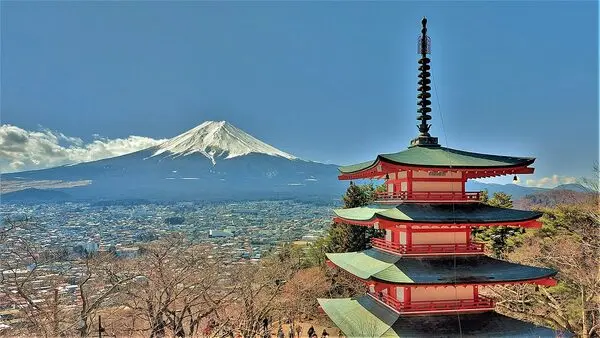
Why Japan in 2026
One number explains the crowds: roughly 150 yen to the US dollar. The yen has stayed weak against the dollar, pound, euro, and Australian dollar, which means a country that used to feel expensive now sits mid-table on daily spend. A bowl of ramen runs around 900 to 1,200 yen, a business-hotel room around 9,000 to 14,000 yen, and a bullet-train seat that would cost a fortune elsewhere is a fixed, honest fare. For US, UK, CA, and AU passport holders the entry side is just as easy: a short tourist stay is visa-free for up to 90 days on arrival, confirmed on Japan's Ministry of Foreign Affairs visa-exemption page.
The catch is that everyone else did the same maths. Japan is running record inbound numbers, so the popular months and the marquee sights are seriously busy. That does not spoil the trip, it just changes how you plan it: book the bullet-train seats and the headline restaurants ahead, pick your season deliberately, and build in a day or two off the most-trodden path. Do that and Japan in 2026 is high value, not just cheap. If you are still deciding between destinations, it also ranks near the top of our best places to travel in 2026.
Plan on roughly ¥8,000–12,000 a day as a backpacker (hostels, konbini and cheap eats, IC-card local transport), ¥15,000–25,000 mid-range (business hotels, restaurant meals, the odd bullet train), and ¥30,000–50,000 for comfort (4-star rooms, guided experiences, taxis). At around ¥150 to the dollar that is roughly $55–80, $100–165, and $200–330 a day. Flights and the JR Pass sit on top.
Timing your visit
Two windows carry the reputation, and both deliver. Cherry blossom peaks in central Japan in late March and early April: the Japan Meteorological Corporation forecast has Tokyo opening around March 19 and hitting full bloom near March 27 in 2026, with Kyoto full a few days later around April 1. Your safest bet for catching Tokyo, Kyoto, and Osaka in bloom together is roughly March 29 to April 7. Bloom moves north with the calendar, so Hokkaido waits until late April into mid-May. It is the most beautiful and the most expensive fortnight of the year, so lock lodging and trains early.
Autumn colour is the quieter twin and, for value, the smarter pick. Kyoto, Osaka, and Tokyo usually peak from late November into early December, with a reliable window around November 18 to early December; go earlier, late September through mid-October, if Hokkaido, Tohoku, or the Japan Alps are the priority. Weather is crisp, the maples are genuinely worth the trip, and rates sit below blossom season.
The month to think hard about is August. It is hot and very humid across the main islands, typhoon risk climbs, and the mid-month Obon holiday sends domestic travel and prices up. Winter is underrated in the other direction: December to February is cold but dry in the cities, cheaper, and pairs sightseeing with world-class snow in Hokkaido and Nagano. If you are weighing these cherry-blossom and autumn windows against trips to other countries, our best time to visit guide lines up the month-by-month picture elsewhere.
Where to go: a first route
A first trip almost always runs the corridor between Tokyo and Osaka, and it should. The bullet train links the three anchor cities in a couple of hours each, so a week to ten days covers them without rushing. Here is the shape most people should copy.
Tokyo (3–4 nights)
Start here. Tokyo is the arrival airport for most long-haul flights and the easiest place to shake off jet lag while there is plenty to do at any hour. Split your days between the loud and the calm: Shibuya and Shinjuku for the neon and the food, then Yanaka, the Meiji Shrine forest, or a day trip to Kamakura or Nikko when the city gets to be too much. Three nights is the floor, four if you want a day trip. Base yourself near a Yamanote Line station and the whole city opens up on one IC-card tap.
Kyoto & Osaka (3–4 nights)
Two and a half hours west on the Tokaido Shinkansen, Kyoto and Osaka work as a pair. Kyoto is the temples, gardens, and old streets, best walked early before the tour buses land at Fushimi Inari and Arashiyama. Osaka, twenty minutes further, is the counterweight: brasher, cheaper for a bed, and the better place to eat late. Many travellers sleep in Osaka and day-trip into Kyoto, which keeps costs down. There is a quieter truth here too: the famous spots feel very different at 7am with the light low and the crowds still asleep, and the day you give one temple your full attention tends to outlast the six you speed-walked.
Beyond the Golden Route
If you have more than a week, step one stop off the main line. Kanazawa gives you a preserved samurai and geisha district and one of Japan's great gardens with a fraction of Kyoto's crowds. Hiroshima and the island of Miyajima add weight and a different pace. Hakone or the Kiso Valley trade cities for onsen and old post towns. None of this needs a car, the trains reach all of it, and each night away from the Tokyo-Kyoto-Osaka axis is usually a cheaper and calmer one.
Trains, passes, and IC cards
Two systems cover almost everything: the nationwide Japan Rail Pass for long hops, and a prepaid IC card for daily travel. The pass is where the 2026 change matters most, and it no longer pays for as many people as it used to.
One more piece: Japan still runs on cash more than visitors expect. Big hotels, chains, and konbini take cards everywhere, but small restaurants, temples, markets, and rural stops are often cash-only, so carry a few thousand yen and pull more from a 7-Eleven or post-office ATM, which reliably take foreign cards. To search trains and navigate on the move you will want data from the moment you land, sort a travel eSIM before you fly with our guide to staying connected abroad.
The JR Pass is not a default anymore. Two bullet-train hops and it loses; a real cross-country loop and it still wins. Price your route, not the hype.
What a week costs
Put the daily tiers over seven days and the shape of a Japan trip gets clear. On the ground, a backpacker week lands around ¥56,000–84,000 (roughly $370–560): hostel dorms, konbini breakfasts and cheap set lunches, IC-card local trains, individual bullet-train tickets rather than the pass. A mid-range week runs around ¥105,000–175,000 (roughly $700–1,165): business hotels, restaurant dinners, a couple of paid experiences, and a JR Pass if your route earns it. A comfort week sits around ¥210,000–350,000 (roughly $1,400–2,330) before flights, with 4-star rooms, guided days, and taxis. International airfare is separate and usually the line that dwarfs all the others, so book it early using our cheap-flights playbook.
- Do get an IC card on day one and add it to your phone wallet, it covers transit and konbini
- Do price the JR Pass against your real route before buying, it often loses on a two-city trip
- Do reserve bullet-train seats and top restaurants ahead in blossom season and around holidays
- Do carry cash for temples, markets, and small restaurants, and refill at 7-Eleven ATMs
- Don't assume the JR Pass is automatic, it only pays for genuine long-distance ground
- Don't plan a first trip for August, the heat, humidity, typhoons, and Obon prices all peak
- Don't try to cram five cities into a week, the transit time eats the days you came for
Frequently asked questions
No. Citizens of the US, UK, Canada, and Australia enter Japan visa-free for tourism for up to 90 days, confirmed on Japan's Ministry of Foreign Affairs. You need a passport valid for your stay and, in practice, a return or onward ticket. Registering on Visit Japan Web before arrival gives you QR codes for immigration and customs and speeds up the airport. Japan's planned JESTA pre-authorisation passed into law in 2026 but launches later this decade, so it is not required for 2026 or 2027 travel. Entry rules can differ by passport, so cross-check the exemption page linked above for your own nationality while you are still booking.
Only if you cover real distance. The nationwide 7-day ordinary pass is around ¥50,000, rising to ¥53,000 from October 1, 2026, on overseas sales. It roughly breaks even once you do a Tokyo-Kyoto-Osaka trip plus another long return leg, such as a round trip to Hiroshima. If your week is mostly Tokyo with a single bullet-train hop to Kansai and back, buying individual reserved tickets usually costs less than the pass. Price your exact itinerary against the fares first, the pass is no longer the automatic choice it once was.
Any of them, they work nationwide. Suica, ICOCA, and Pasmo are interoperable across Japan and pay for local trains, buses, convenience stores, and vending machines on a tap. The easiest option is adding Suica or Pasmo to Apple Pay or Google Wallet and topping up from your phone; for plastic, the deposit-free Welcome Suica or the Tourist Pasmo are sold at Narita and Haneda. You still want some cash: big hotels and chains take cards, but many small restaurants, temples, and rural spots are cash-only. Pull yen from a 7-Eleven or post-office ATM, both reliably accept foreign cards.
Two windows lead. Cherry blossom peaks in central Japan in late March and early April, with the safest run for Tokyo, Kyoto, and Osaka together around March 29 to April 7, 2026; the experience is unmatched but it is the priciest and busiest fortnight of the year. Autumn colour peaks in those cities from late November into early December and offers similar beauty for lower rates and thinner crowds, the smarter pick if you can choose. Winter is cold, dry, and cheaper in the cities with excellent snow up north. The one window to approach carefully is August: hot, very humid, typhoon-prone, and pushed up by the Obon holiday.
Seven to ten days is the ideal length for a first visit. That covers the classic route comfortably: three to four nights in Tokyo, then three to four across Kyoto and Osaka, linked by a two-and-a-half-hour bullet train. Five days is doable but tight, and you will feel the transit time. With ten days or more, add one stop off the main line, Kanazawa, Hiroshima and Miyajima, or an onsen town like Hakone, rather than squeezing in another big city. Depth beats breadth here; the trip improves the fewer places you try to fit.
Pick the season first, blossom for the spectacle, autumn for the value, and steer clear of August. Book flights early and price the JR Pass against your actual route instead of buying it by reflex. Load an IC card onto your phone and keep some cash for the small places. Then keep the map tight: three cities in a week, one detour if you have ten days. Do that and the weak yen turns a bucket-list trip into an affordable one. It is the trip our team plans more than any other right now, and the one we most enjoy talking readers into.