


Most people book Thailand as one destination and then act surprised that it feels like several. It is a big country, roughly the size of France, and the useful way to plan it is as three regions that want different things from you: Bangkok, the fast, flat, temple-and-traffic capital; the north around Chiang Mai, cooler, greener, and slower; and the islands, split across two coasts that are almost never both dry at the same time. Get those three straight and the rest of the trip plans itself. This guide covers the money, the calendar, the transport, and the traps, with the 2026 numbers rather than the ones travel blogs copied from 2019.
The three Thailands
You do not have to do all three on one trip, and if you have under ten days you probably should not. But knowing what each region is for stops you wasting days in transit or landing somewhere in its wrong season. Splitting the country this way is how our writers plan their own trips here, and it heads off more trouble than any single tip below.
Bangkok
Bangkok is the arrival point for almost everyone and worth two or three days on its own. The temples and river sit in the old town, the food is the cheapest good food you will eat anywhere, and the elevated BTS Skytrain and metro let you skip the traffic that otherwise eats hours. It is hot, loud, and relentless, and that is the point. Budget travelers can live here on well under $30 a day; the same city will happily take $300 if you let the rooftop bars talk you into it. Two full days covers the Grand Palace, Wat Pho, a canal boat, and a night market without rushing.
The north (Chiang Mai)
Fly or take the overnight train an hour into the air and 700-odd kilometres north and the pace drops. Chiang Mai is the hub: a walkable old city inside a moat, mountains behind it, and roughly half the price of the islands for a room. This is the base for ethical elephant sanctuaries, cooking classes, and trips further north to Pai and Chiang Rai. One hard rule: avoid March and April, when farmers burn crop stubble across the north and the air quality collapses into a grey haze that can push into the hazardous range. Come November to February instead, when it is dry, clear, and pleasantly cool at night.
The islands
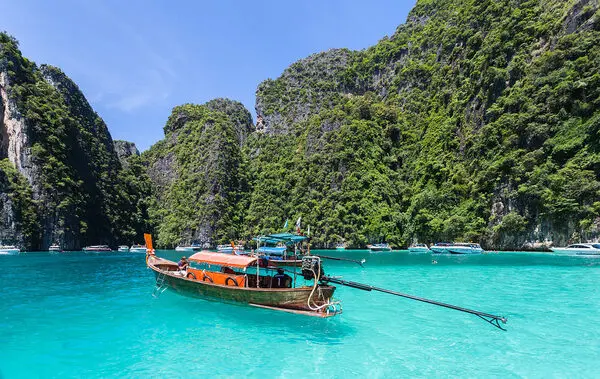
The beaches are why most first-timers come, and they split into two camps. The Andaman coast on the west, Phuket, Krabi, Koh Phi Phi, Koh Lanta, Koh Lipe, has the postcard limestone karsts and the clearest water. The Gulf coast on the east, Koh Samui, Koh Phangan, Koh Tao, is flatter, cheaper to reach on some routes, and home to the Full Moon Party and the best budget diving in the country off Koh Tao. The catch is the weather, and getting it right matters more than any other call you make about Thailand, so it gets its own section next.
When to go (it depends on the coast)
Thailand does not have one season, it has two coasts on opposite monsoon cycles. When the Andaman side is calm and dry, the Gulf side is often getting rained on, and the other way round. The broad national high season is November to March, dry and cooler nationwide, which is also when prices and crowds peak. April is the hottest month, regularly around 40°C inland, and it ends with Songkran, the water-fight new year, in mid-April. If your dates are fixed, let the table pick the coast rather than fighting the sky.
| Region | Best months | Avoid | Note |
|---|---|---|---|
| Bangkok | Nov–Feb | Apr (peak heat, ~40°C) | Cool, dry window; April is the hottest month before the rains arrive |
| The north (Chiang Mai) | Nov–Feb | Mar–Apr (burning-season haze) | Crop-burning smoke chokes the air roughly Feb–Apr; skip those weeks outright |
| Andaman coast (Phuket, Krabi) | Nov–Apr | May–Oct (Sep–Oct wettest) | West coast; driest with the calmest seas through the northern winter |
| Gulf coast (Samui, Tao) | Feb–Sep | Oct–Dec (Nov wettest) | East coast; runs opposite the Andaman, still fine when the west is soaked |
The practical read: if you can only travel in June, July, or August, book the Gulf (Samui, Phangan, Tao) and skip Phuket, which is mid-monsoon. If you travel in the northern winter, the Andaman is at its best and the whole country is dry. The two shoulder windows where both coasts are usually workable are roughly late February to April and November, though April brings the heat and Songkran. Thailand is far from the only place where the calendar quietly decides the trip; our best-time-to-visit guide lays out the dry windows and shoulder months country by country.
Thailand does not have a season, it has two coasts. Pick the one that is dry when you can travel, not the one on the postcard.
Daily budget
Thailand remains one of the best value-for-money countries on earth, which is exactly why it stays busy. A backpacker who eats street food and sleeps in dorms runs on roughly ฿900–1,500 a day, around $25–40, drawing on 2026 figures from Budget Your Trip and Numbeo. Step up to private aircon rooms, sit-down restaurants, and the odd internal flight and you are looking at roughly $80–150 a day. There is no ceiling above that; five-star Bangkok and private-villa Phuket will take whatever you hand them.
The north is cheaper than the islands by a wide margin, often close to half the room rate for the same standard, so a common move is to load the budget days in Chiang Mai and spend up on the coast. One line item to note: Thailand has repeatedly floated a 300-baht (~$9) tourist arrival fee, and it has been postponed more than once, so treat it as pending and check its status on the official Thai tourism portal at booking time rather than budgeting for it blind.
- Budget day (~฿900–1,500 / $25–40): dorm bed for ฿170–250 ($5–7), street meals at ฿50–150 ($1.50–4) each, songthaews and the BTS, overnight sleeper trains between regions
- Free or near-free by default: most beaches, temple grounds, markets, and viewpoints cost nothing or a few dollars
- The north stretches it furthest, Chiang Mai and Pai run roughly half the island price for a room of the same standard
- Comfort day (~$80–150): private aircon room or midrange hotel, restaurant meals with a couple of drinks, internal flights instead of trains, Grab taxis and private transfers
- The islands are the budget-killer, Phuket and Samui rooms, ferries, and day tours cost multiples of the mainland
- Alcohol is the quiet drain, imported spirits and cocktail bars are priced closer to Western levels than the food is
Moving around the country
Distances are large but the network is good and cheap, so you rarely need to overthink it. For the long north-south hops, internal flights are the sane default: AirAsia, Thai Lion Air, and Nok Air connect Bangkok to Chiang Mai, Phuket, and Krabi in about 90 minutes, and booked a few weeks out the fares often land around $30–60 one way, less than the time you would burn on the road. Bangkok has two airports, Suvarnabhumi (BKK) for most full-service flights and Don Mueang (DMK) for the budget carriers, so check which one your ticket uses before you commit to a transfer.
For the romance and the saved hotel night, the overnight sleeper train from Bangkok to Chiang Mai is a genuinely good option: a second-class aircon berth runs roughly $30–40 and you wake up in the north. Book it a few days ahead through the State Railway of Thailand, as the sleeper berths sell out. Within cities, use the metered Grab app to sidestep taxi-meter arguments, and for the islands the ferries and speedboats are frequent and cheap, though they thin out or stop entirely in each coast's monsoon, which is one more reason to get the season right. Skip renting a scooter unless you are already a confident rider; road injuries are the most common serious problem foreign visitors hit here, and many travel policies exclude them if you have no motorcycle licence.
Scams and staying safe
Thailand is a safe country for tourists in the ordinary sense, violent crime against visitors is rare, but it runs a well-oiled set of tourist scams, and knowing the scripts defuses almost all of them. The Tourist Police line is 1155, in English, and is the right call for any dispute before you hand over money.
- The "it's closed today" scam. Near the Grand Palace and other big Bangkok temples, a friendly, often official-looking stranger tells you the site is shut for a ceremony or holiday and offers a tuk-tuk to somewhere better. It is a lie; the major temples open every day. Walk to the actual gate and check for yourself.
- The tuk-tuk shopping tour. A suspiciously cheap or free tuk-tuk ride that detours through a tailor, a gem shop, and a jeweller, each paying the driver commission and hard-selling you. Decline the tour and use Grab for a metered price instead.
- The jet-ski and scooter damage claim. You rent, return it, and the operator points at pre-existing scratches and demands ฿10,000–50,000 in "repairs." Film the vehicle from every angle before you take it, never leave your actual passport as deposit (a photocopy only), and call 1155 rather than paying under pressure.
- Taxi meter "broken." Airport and tourist-zone drivers who refuse the meter and quote a flat inflated fare. Insist on the meter or walk to the Grab pickup; at Suvarnabhumi use the official metered-taxi rank on the ground floor.
- Overpriced gems and "investment" jewellery. Anyone steering you toward a can't-lose gemstone deal is running a decades-old con; there are no bargain investment sapphires waiting for tourists.
- Drink and safety basics. Watch your drink at the full-moon and hostel parties, use a hotel safe for your passport, and buy travel insurance that explicitly covers scooters if you plan to ride.
Frequently asked questions
As of July 2026, citizens of the US, UK, Canada, Australia, and around 90 other countries can still enter visa-free under the 60-day exemption introduced in July 2024. However, Thailand's cabinet approved cutting that back to 30 days in May 2026, and the change takes effect 15 days after it is published in the Royal Gazette, which had not happened at the time of writing. So the 60-day rule may already be 30 by the time you travel. Everyone must also complete the free online Thailand Digital Arrival Card (TDAC) within 72 hours before arrival. Because the stay length is mid-change, verify the exact number of visa-free days and the TDAC steps with Thai immigration or your nearest Thai embassy while you are planning the trip.
It depends entirely on when you travel, because the two coasts run opposite seasons. The Andaman coast (Phuket, Krabi, Phi Phi, Koh Lipe) is at its best from roughly November to April, dry with calm, clear water, and has the dramatic limestone scenery. The Gulf coast (Koh Samui, Koh Phangan, Koh Tao) holds up well from about February to September, so it is the one to pick if you can only travel in the northern summer, when the Andaman is under monsoon. Koh Tao is also the country's cheapest place to learn to dive. Match the coast to your dates and you avoid the rain either way.
A budget traveler eating street food and sleeping in dorms runs on roughly ฿900–1,500 a day, about $25–40, per 2026 Numbeo and Budget Your Trip data. A midrange or comfort day with private aircon rooms, restaurant meals, and the occasional internal flight lands closer to $80–150, and luxury has no ceiling. The north (Chiang Mai, Pai) is markedly cheaper than the islands, often near half the room rate, so a smart split loads the cheap days inland and spends up on the coast. Note a possible 300-baht arrival fee that has been repeatedly postponed; confirm whether it is in force before you travel.
Yes, in the everyday sense: violent crime against visitors is uncommon and millions travel the country each year without trouble. The real risks are more mundane. Scooter and road accidents are the most common serious injury foreign visitors face, so only ride if you are experienced and insured for it. Scams are widespread but almost entirely avoidable once you know the scripts, the closed-temple con, tuk-tuk shopping tours, and jet-ski damage claims chief among them. Keep your passport in a hotel safe, watch your drink at parties, use metered Grab rides, and save the Tourist Police number, 1155, in your phone.
For the long hops, internal flights are the practical default: AirAsia, Thai Lion Air, and Nok Air link Bangkok to Chiang Mai, Phuket, and Krabi in around 90 minutes, often for about $30–60 booked ahead. Check whether your flight uses Suvarnabhumi (BKK) or the budget-carrier hub Don Mueang (DMK). The overnight sleeper train to Chiang Mai is a good-value alternative at roughly $30–40 for an aircon berth and saves a hotel night. Within cities use the Grab app for metered fares, and reach the islands by frequent ferries and speedboats, which cut back or stop in each coast's monsoon.
Treat Thailand as three trips and let the calendar choose which coast: November to April points you at the Andaman and the whole country is dry; the northern summer sends you to the Gulf instead. Budget from about ฿900–1,500 a day as a backpacker or $80–150 for comfort, fly the long hops for $30–60, memorise the closed-temple and jet-ski scams, and double-check the current visa stay length with Thai immigration while you plan, since the rules are shifting through 2026. Get the timing right and few places stretch a travel budget this far. Ready for the sand? Weigh the coasts against the rest in our best beach destinations guide.