


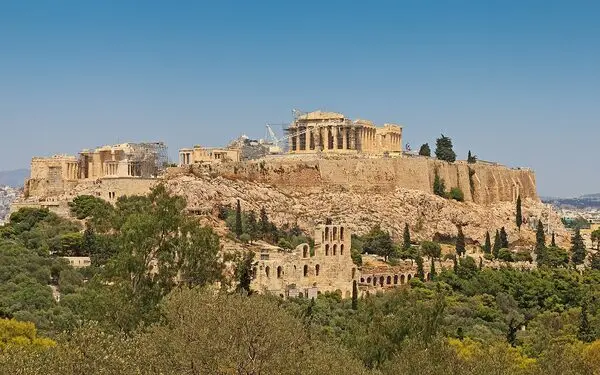
The mistake most first-time visitors make is treating Greece as a single destination with a single best answer, then trying to see all of it in ten days. What you actually have to choose between is two very different rhythms: the slow, sun-bleached island days that show up on every postcard, and a mainland of mountain villages, ancient sites, and long lunches that most itineraries skip entirely. You can combine them, and many people do, but the trip works far better when you decide early which one is the spine and which one is the side trip. That first call is where RealRoute begins every Greek itinerary, long before anyone books a ferry.
Islands or mainland?
Before you get lost comparing individual islands, it helps to zoom out and ask which half of the country you're really coming for. The islands and the mainland run on different clocks, cost different amounts, and reward completely different kinds of traveler. This is the decision that shapes everything after it, including how much time you spend on ferries and how much you spend simply being somewhere.
| The islands | The mainland | |
|---|---|---|
| Vibe | Slow beach days, whitewashed towns, sea everywhere you look | Ancient sites, mountain villages, cities and long tavern lunches |
| Best for | First-timers, couples, beach and swimming, the classic Greek daydream | History, road trips, hiking, travelers who want fewer crowds |
| Cost | Higher on marquee islands, moderate on the quieter ones | Generally lower, especially outside Athens |
| Getting around | Ferries and the odd short flight; slower and weather-dependent | Rental car or buses; you keep moving on your own schedule |
| Best months | May–Jun and Sep for warm sea without the peak crush | Apr–Jun and Sep–Oct; even winter works for cities and ruins |
If it's your first time and you have a week, lean islands, because that is the Greece your imagination has already booked, and there's no shame in wanting it. If you've been before, or you travel to walk and read plaques rather than lie on sand, the mainland gives you more room and better value, and you'll share the big archaeological sites with a fraction of the summer coach crowds. One honest caveat before you commit: a week split evenly between the two often means you spend the middle of your trip in transit rather than anywhere, so if you only have seven days, pick a side.
Which islands
There are around 200 inhabited Greek islands, which sounds paralyzing until you realize you'll choose a group, not a scatter of individual dots. Ferries run cleanly within a group and awkwardly between them, so picking your cluster first is the one call that keeps island hopping from turning into a logistics headache. Three groups cover most first and second trips.
The Cyclades: the classic daydream
This is the Greece of the brochures, whitewashed cubes tumbling down to a blue you won't quite believe, and it's the group most people mean when they say they want to see the islands. The trade-off is that the two famous names, Santorini and Mykonos, now run close to peak crowds and peak prices for a long stretch of the year, and they can feel more like a queue than a getaway in high summer. The quieter Cyclades give you the same light and architecture for noticeably less, and they're where the group actually feels like itself. A sensible shortlist:
- Naxos, the largest and most self-sufficient, with real villages, long sandy beaches, and the best value of the famous names.
- Paros, central, well-connected, and an easy hub for day trips to smaller islands nearby.
- Milos, otherworldly coves and volcanic rock, quieter than its neighbors but rising fast.
- Santorini, still worth the caldera view once, but plan for crowds and book far ahead.
- Mykonos, for nightlife and beach clubs; skip it if that's not your trip.
Crete: an island that behaves like a country
Crete is big enough to be its own trip, and it rewards travelers who want variety without a ferry every other morning. You get Venetian harbor towns, a serious food culture, gorges you can hike for hours, and beaches at the far west and south that feel genuinely remote. Because it's so large, you'll want a rental car rather than the ferry-and-taxi shuffle that works on smaller islands, and you can happily fill a full week here without repeating yourself. It's also a strong shoulder-season choice, since the south coast stays warm later into autumn than most of the Aegean, though the distances mean you should resist the urge to see all of it and instead base yourself in one or two regions.
The Ionian: greener, softer, Italian-tinged
Off the west coast, the Ionian islands look and feel different: greener, more forgiving, with a Venetian rather than Cycladic accent and calmer seas that suit families and nervous swimmers. This is where you go if the stark white-and-blue of the Aegean isn't quite your fantasy and you'd rather have cypress hills running down to turquoise bays. Corfu is the anchor and the easiest to reach, with the smaller islands quieter still:
- Corfu, the most connected, with a UNESCO-listed old town and enough range to fill a week on its own.
- Kefalonia, dramatic beaches and mountain drives, a favorite for slower road trips.
- Zakynthos (Zante), home to the famous shipwreck cove, busy in summer but stunning off-peak.
- Paxos, tiny and low-key, an antidote if the bigger islands feel too polished.
Getting around: the ferry reality
Island hopping sounds romantic, and often is, but it runs on a ferry network that rewards a little planning and punishes none at all. In 2026 dozens of ferries leave the mainland ports daily for the island groups, run by operators like Blue Star, Seajets, Minoan Lines, and Golden Star, in a mix of slow conventional boats and faster high-speed catamarans. The pattern that keeps you sane is the one the operators themselves recommend: choose your island group first, then the mainland port, and only then the exact route, rather than trying to zigzag between groups. You can compare schedules and book across companies on a single platform like Ferryhopper, and it's worth confirming exact 2026 times on the operator's own site before you lock a tight connection.
Season by island
Greece has a famously short window where everything lines up, and knowing it changes the entire feel of the trip. Late May into June and September are the ideal weeks: the sea is warm enough to swim, the light is extraordinary, the towns are lively without being overrun, and prices sit well below the summer ceiling. September in particular gives you the warmest water of the year, since the sea holds the summer's heat, with crowds and rates easing noticeably after mid-month. April, early May, and October are cooler and quieter still, lovely for hiking, cities, and ancient sites, though some island businesses haven't opened or have already closed for the season.
July and August are the trip everyone pictures and the one that tests your patience. The islands are gorgeous, but they're also crowded, expensive, and hot, with interior temperatures that can push past 40°C and the dry Meltemi winds that both cool the Aegean and cancel high-speed ferries. August is the peak of the peak, because Greeks take their own holidays then, so prices climb and the popular islands fill to the brim. If summer is the only time you can travel, it can absolutely still be wonderful, just book everything early, favor the larger islands that absorb crowds better, and build slack into your ferry days. If you want to see how Greece's May-to-September rhythm stacks up against other countries you might pair it with, our best-time-to-visit guide lays out the month-by-month picture destination by destination.
The cost of a Greek week
Greece stretches to fit your budget, and the lever that moves it most is which islands you choose. Santorini and Mykonos run roughly 40–60% more than equivalent quality on Naxos, Paros, or the mainland, so swapping the marquee names for their quieter neighbors is the cleanest way to cut costs without cutting the experience. As a rough daily guide drawing on Budget Your Trip and Numbeo, budget travelers can get by on around $50–70 a day with hostels and casual meals, while a comfortable mid-range day lands closer to $100–150 once you add a private room, a few boat trips, and dinners out. Shoulder-season dates trim another 20–30% off accommodation for nearly the same weather.
- Choose the quieter Cyclades over Santorini and Mykonos for the same light at a lower price
- Travel in late May, June, or September for warm sea, thinner crowds, and softer rates
- Stay within one island group to keep ferry connections simple and frequent
- Base yourself on Crete or a larger island to fill a week without constant packing
- Don't try to split a single week evenly between islands and mainland, you'll live on ferries
- Don't island-hop on the day you fly home, a wind-cancelled ferry can strand you
- Don't assume August is best just because it's summer, it's the most crowded and costly month
Frequently asked questions
Aim for late May into June or September. You get warm water, strong light, lively but not overwhelming towns, and prices well under the summer peak; September holds the warmest sea of the year and quiets down noticeably after mid-month. July and August are the classic postcard but also the hottest, priciest, and most crowded stretch, with Meltemi winds that can cancel high-speed ferries, and August is busiest of all because Greeks take their own holidays then. April, early May, and October are cooler and calmer, ideal for cities and ancient sites, though some island businesses stay shut off-season.
For summer travel on popular routes, yes. Reserve roughly one to three months ahead for June through September on marquee crossings like Athens to Santorini or Mykonos, and earlier still if you need a vehicle space or a cabin. Slower conventional ferries and quieter routes leave more slack. Pick your island group first, then the mainland port, then the exact route, and compare operators on a platform like Ferryhopper. Two cautions: high-speed catamarans are cancelled more readily than big conventional boats when the Meltemi blows, and never schedule a ferry on the day you fly home.
For a short holiday, no visa is required for US, UK, Canadian, and Australian citizens; you can stay in the Schengen Area, which includes Greece, for up to 90 days in any 180-day period. The change to watch is ETIAS, the EU's new travel authorization, which is expected to launch in the last quarter of 2026 with a transitional grace period before it becomes strictly enforced. It's an online pre-registration, not a visa, but you'll eventually need to apply and pay a small fee before you travel. Because the launch timing keeps shifting, double-check where ETIAS actually stands for your passport on the official ETIAS page, and use our visa requirements guide for the wider picture, rather than trusting a date you read months earlier.
It depends heavily on which islands and which month. As a rough guide, a budget traveler can manage around $50–70 a day with hostels and casual meals, while a comfortable mid-range day runs closer to $100–150 once you add a private room, boat trips, and dinners out, so a week lands somewhere between roughly $350 and $1,000-plus per person before flights. Santorini and Mykonos cost around 40–60% more than the same quality on Naxos, Paros, or the mainland, and traveling in shoulder season trims another 20–30% off accommodation. Swapping the famous islands for quieter ones is the biggest single saving available.
Decide your spine first, islands or mainland, then pick one island group and stay inside it so the ferries stay simple. Target late May, June, or September for the warm-sea, lighter-crowd window, swap the marquee islands for quieter neighbors to stretch your budget, and leave a real buffer before any flight home. Get those four calls right and the rest of the trip mostly takes care of itself. If a specific stretch of sand is what you're chasing, our best beach destinations guide weighs which Greek coves earn the detour, and our best places to travel roundup shows where else the Mediterranean pays off in 2026.